
Understanding What Really Drives a Customer to Buy
Successful selling is not about simply presenting a product or pushing for a quick sale. It is about understanding the customer, identifying what motivates them, and offering the right solution at the right time and within their ability to invest.
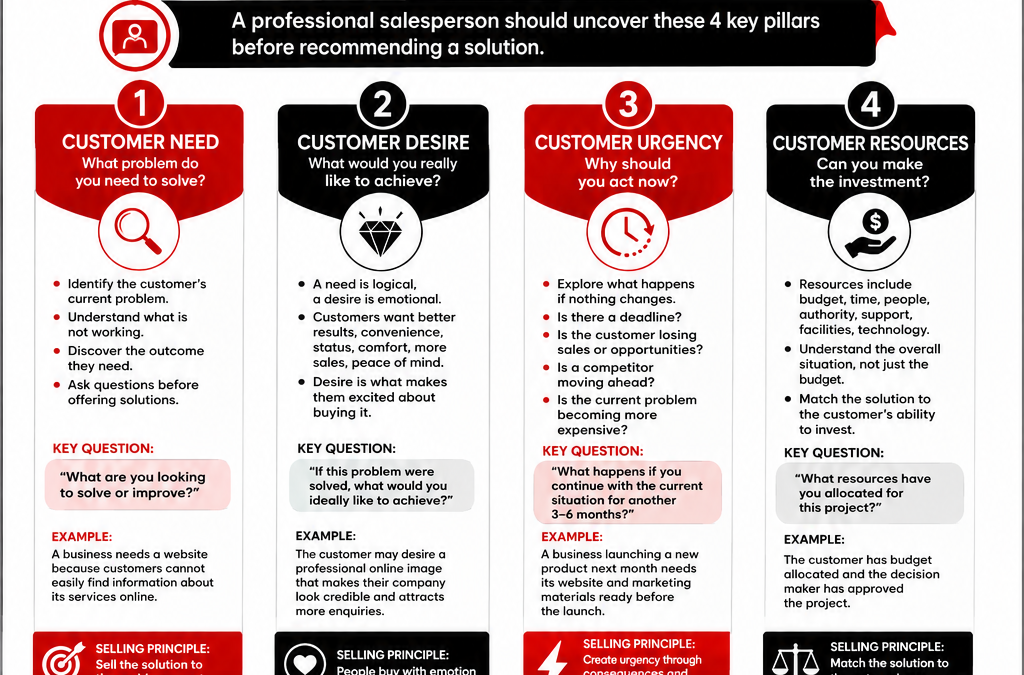
A professional salesperson should uncover these 4 key pillars before recommending a solution:
- CUSTOMER NEED — “What problem do you need to solve?”
Every purchase begins with a need. The customer may have a problem, challenge, requirement, or gap that needs to be addressed.
Salesperson’s focus:
- Identify the customer’s current problem.
- Understand what is not working.
- Discover the outcome they need.
- Ask questions before offering solutions.
Key Question:
“What are you looking to solve or improve?”
Example:
A business needs a website because customers cannot easily find information about its services online.
Selling principle:
Sell the solution to the problem — not just the product.
- CUSTOMER DESIRE — “What would you really like to achieve?”
A need is often logical, while a desire is emotional. Customers may need a solution, but their desire is what makes them excited about buying it.
They may want:
- Better results
- More convenience
- Higher status or credibility
- Greater comfort
- More sales
- Peace of mind
- A better lifestyle or experience
Key Question:
“If this problem were solved, what would you ideally like to achieve?”
Example:
The customer may not simply want a website. They may desire a professional online image that makes their company look credible and attracts more enquiries.
Selling principle:
People buy with emotion and justify with logic.
- CUSTOMER URGENCY — “Why should you act now?”
A customer can have a genuine need and strong desire but still delay the purchase.
Your job is to understand the reason for taking action now.
Explore:
- What happens if nothing changes?
- Is there a deadline?
- Is the customer losing sales or opportunities?
- Is there a seasonal opportunity?
- Is a competitor moving ahead?
- Is the current problem becoming more expensive?
Key Question:
“What happens if you continue with the current situation for another 3–6 months?”
Example:
A business launching a new product next month needs its website and marketing materials ready before the launch.
Selling principle:
Create urgency through consequences and opportunities — never through unnecessary pressure.
- CUSTOMER RESOURCES — “Can you make the investment?”
Even when the customer has a need, desire and urgency, the sale still needs to be financially and practically achievable.
Resources can include:
- Budget
- Time
- People
- Decision-making authority
- Internal support
- Available facilities or technology
Instead of asking only:
“What is your budget?”
Try understanding the customer’s overall situation:
“Have you allocated a budget for this project?”
“Who will be involved in making the final decision?”
“What resources do you already have available?”
Selling principle:
Match the solution to the customer’s resources — don’t oversell beyond their ability to invest.
The 4 Pillars Working Together
Think of the selling process as:
NEED → DESIRE → URGENCY → RESOURCES → DECISION
When all four pillars are strong, the probability of a successful sale increases significantly.
| Pillar | What You Discover | Key Question |
| Customer Need | What problem must be solved? | “What do you need to improve?” |
| Customer Desire | What result do they really want? | “What would you ideally like to achieve?” |
| Customer Urgency | Why act now? | “Why is this important at this time?” |
| Customer Resources | Can they invest and implement? | “What resources have you allocated?” |
The Golden Rule of Selling
Don’t start by selling your product. Start by understanding your customer.
When you understand what they need, what they desire, why they need it now, and what resources they have, you can position your product or service as the right solution rather than just another sales offer.
Great salespeople don’t convince customers to buy.
They help customers discover why buying the right solution makes sense.
