
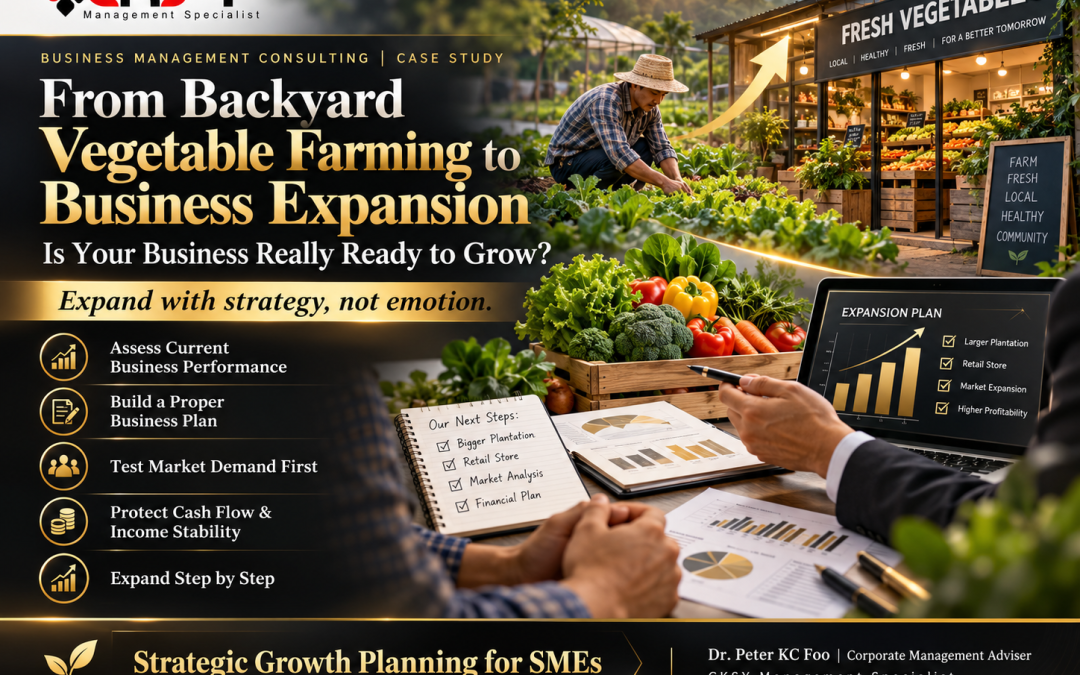
Before You Invest in Business Expansion, Make Sure Your Business Is Ready to Grow.
The Background: A Small Business with Big Ambitions
Recently, I was approached by an aspiring entrepreneur seeking professional advice on expanding his small vegetable farming business.
He currently works full-time in the hotel industry while cultivating vegetables in his home garden during his spare time. What initially started as a small-scale farming activity has gradually developed into a promising side business.
Through dedication and consistent effort, he has successfully supplied fresh vegetables to several local food and beverage (F&B) restaurants. Encouraged by the positive response and growing customer demand, he is now considering taking his business to the next level.
His proposed expansion includes:
- Acquiring or leasing a larger agricultural area to increase vegetable production.
- Renting a physical retail shop to sell fresh vegetables directly to surrounding residential communities and walk-in customers.
- Continuing to supply existing F&B restaurant customers while exploring additional business opportunities.
- Potentially resigning from his full-time employment to concentrate on the business.
On the surface, this appears to be an exciting business opportunity. However, from a business management and strategic planning perspective, several important questions must be addressed before committing to such a significant investment.
A business opportunity does not automatically mean the business is ready for expansion.
My Initial Business Assessment: Growth Opportunities Versus Financial Risks
During our preliminary consultation, I highlighted that business expansion should not be driven solely by positive customer feedback, personal enthusiasm, or the desire to become a full-time entrepreneur.
While his existing business has demonstrated early market acceptance, expanding from home-based vegetable cultivation into larger-scale agricultural production and retail operations introduces an entirely different level of business complexity.
The proposed expansion would involve additional financial commitments, operational responsibilities, and commercial risks.
1. Financial Exposure and Cash Flow Risk
Renting a shop and expanding agricultural production require upfront capital and recurring financial commitments.
These may include rental deposits, renovation, equipment, refrigeration, utilities, staffing, transportation, packaging, agricultural inputs, and other operating expenses.
Without reliable sales projections and adequate working capital, the business could experience cash flow difficulties even when customer demand exists.
2. Uncertain Retail Market Demand
Supplying vegetables to restaurants is different from operating a physical retail store.
Restaurant customers generally purchase according to business requirements, whereas retail customers are influenced by convenience, pricing, product freshness, location, purchasing habits, and competing sellers.
Positive demand from existing restaurant customers does not guarantee sufficient walk-in sales to sustain a retail outlet.
3. Operational Capacity and Inventory Management
Vegetables are highly perishable products.
Increasing production without proper demand forecasting, harvesting schedules, storage facilities, and distribution planning could result in excessive inventory, wastage, and declining profit margins.
The entrepreneur must also consider whether he has the operational capacity to manage farming, harvesting, delivery, procurement, retail operations, and customer service.
4. Personal Financial Security
One of my greatest concerns was the possibility of him resigning from his stable full-time employment and committing a substantial portion of his hard-earned savings to an unproven expansion model.
Entrepreneurship involves calculated risks, but financial decisions should be supported by facts, analysis, and contingency planning.
My advice was clear: Do not sacrifice your financial stability for an expansion that has not yet demonstrated commercial viability.
My Top 7 Strategic Recommendations
Recommendation 1: Conduct a Business Performance Screening Before Expansion
Priority: Critical
Before investing additional capital, the entrepreneur should undertake a structured assessment of his existing business performance.
The assessment should examine:
- Monthly revenue, operating costs, and actual net profit.
- Production volume and current agricultural capacity.
- Customer purchasing frequency and repeat orders.
- Gross profit margins by vegetable category.
- Product wastage, unsold inventory, and delivery costs.
- Available financial resources and operational limitations.
This exercise will help establish whether the existing business is genuinely profitable, scalable, and financially sustainable.
CKSY Advisory: Understand the performance of your existing business before attempting to multiply its size.
Recommendation 2: Develop a Proper Business Plan and Financial Forecast
Priority: Critical
I strongly recommended that he prepare a comprehensive business plan covering the proposed expansion.
The plan should include market analysis, customer segmentation, competitor assessment, production strategy, operational planning, marketing strategy, capital requirements, and financial projections.
More importantly, he should prepare at least three financial scenarios:
- Conservative: Sales are below expectations while operating costs remain relatively high.
- Realistic: Sales grow gradually based on validated customer demand.
- Optimistic: Customer acquisition and production expansion perform above expectations.
Each scenario should include monthly cash flow projections, break-even analysis, working capital requirements, and estimated investment payback periods.
A profitable business on paper may still fail if it cannot generate sufficient cash to meet its financial obligations.
CKSY Advisory: Cash flow determines how long a business can survive. Profitability determines whether it can sustain long-term growth.
Recommendation 3: Validate Retail Demand Before Renting a Shop
Priority: Very High
Instead of immediately committing to a long-term shop rental, I suggested exploring lower-risk sales channels to evaluate consumer demand.
Possible approaches include:
- Weekend vegetable stalls at suitable community markets.
- Pre-order vegetable packages for nearby households.
- WhatsApp ordering and scheduled home deliveries.
- Partnerships with existing grocery shops or minimarkets.
- Subscription-based weekly vegetable baskets.
- Community group purchases and neighbourhood collection points.
These channels allow the entrepreneur to evaluate purchasing behaviour, selling prices, repeat orders, and profit margins before investing in a permanent retail outlet.
CKSY Advisory: Test the market before investing in the market.
Recommendation 4: Expand Production According to Confirmed Demand
Priority: Very High
Rather than acquiring a large agricultural area immediately, the entrepreneur should consider increasing production progressively.
Priority should be given to securing additional restaurant customers, understanding their purchasing requirements, and developing more predictable supply arrangements.
The entrepreneur should also assess production yield, crop cycles, labour availability, weather exposure, transportation, and product spoilage.
An alternative worth evaluating is collaborating with other local vegetable growers to fulfil additional demand before committing to a major plantation investment.
CKSY Advisory: Expand production because demand is growing, not simply because more land is available.
Recommendation 5: Protect Personal Financial Stability and Employment Income
Priority: Critical
I advised the entrepreneur not to rush into resigning from his full-time employment.
His regular salary currently provides financial stability and reduces pressure on the developing business.
A more prudent approach is to maintain employment while gradually building business revenue, customer relationships, operating systems, and financial reserves.
He should only consider transitioning into full-time entrepreneurship when the business demonstrates consistent profitability, sufficient cash flow, reliable demand, and the ability to support his personal financial commitments.
CKSY Advisory: Financial independence should be the result of a sustainable business model, not the assumption behind an untested business expansion.
Recommendation 6: Establish a Clear Brand Positioning and Competitive Advantage
Priority: High
The entrepreneur should consider how his vegetables can be differentiated from those sold by traditional markets, supermarkets, and established grocery retailers.
Potential brand positioning may focus on:
- Locally grown, freshly harvested vegetables.
- Farm-to-table supply and transparent sourcing.
- Consistent product quality and freshness.
- Convenient ordering and neighbourhood delivery.
- Trusted relationships with local restaurants and households.
Any claims relating to organic production, pesticide-free cultivation, or certification must be supported by appropriate evidence.
A strong brand identity, customer trust, and consistent product quality could eventually help him compete on value rather than price alone.
CKSY Advisory: Customers do not necessarily buy from the biggest supplier. They buy from businesses they trust and believe deliver value.
Recommendation 7: Implement a Phased Business Expansion Roadmap
Priority: Critical
Rather than pursuing agricultural expansion, retail investment, and full-time entrepreneurship simultaneously, I proposed a progressive approach.
Phase 1 — Business Assessment and Planning (Month 1–2)
Review financial performance, evaluate production costs, identify profitable products, study customer demand, and prepare a business expansion plan.
Phase 2 — Market Validation (Month 3–4)
Test direct-to-consumer sales through pre-orders, community markets, subscription packages, and delivery services. Measure demand, repeat purchases, and actual contribution margins.
Phase 3 — Controlled Production Expansion (Month 5–6)
Increase production capacity gradually according to verified customer demand. Strengthen restaurant supply relationships and establish more reliable operating procedures.
Phase 4 — Retail Feasibility and Investment Decision (Month 7–9)
Evaluate potential shop locations, rental costs, customer traffic, competitor pricing, projected sales, and break-even requirements. Consider a physical store only if the financial projections and market validation support the investment.
Phase 5 — Sustainable Business Scaling (Month 10–12 and Beyond)
Strengthen branding, distribution, inventory management, customer retention, and financial controls. Review whether the business can support full-time entrepreneurship without placing personal financial security at unreasonable risk.
The timeline is illustrative and should be adjusted according to actual performance, agricultural production cycles, and market conditions.
My Professional Conclusion: Grow Strategically, Not Emotionally
As a Corporate Management Adviser, I always encourage entrepreneurs to pursue opportunities and build their businesses with confidence.
However, I also believe that responsible business advisory involves identifying potential risks before they become costly problems.
In this particular case, the entrepreneur has already demonstrated encouraging progress by transforming a home gardening activity into a small commercial supply business.
That achievement deserves recognition.
Nevertheless, the next stage of growth requires a different mindset — moving from an individual operator to a business owner who understands strategic planning, financial management, operational efficiency, market positioning, and risk management.
My recommendation was not to abandon his expansion ambition, but to develop a structured business plan, validate the opportunities, protect his existing income, and expand in manageable stages.
Business growth is not measured by how quickly you open another shop, acquire more land, or increase your investment. True business growth is measured by sustainable profitability, stronger cash flow, operational capability, and long-term business value.
Final Thought
“Don’t expand your business simply because you see an opportunity. Expand when you have the strategy, financial capacity, proven demand, and operational readiness to turn that opportunity into sustainable success.”
A good entrepreneur sees opportunities. A strategic entrepreneur understands when, how, and whether to invest.
Disclaimer: This case study is based on a preliminary business advisory discussion. Recommendations are illustrative and subject to detailed financial, operational, and market feasibility assessments. Client-identifying information has been omitted.
