
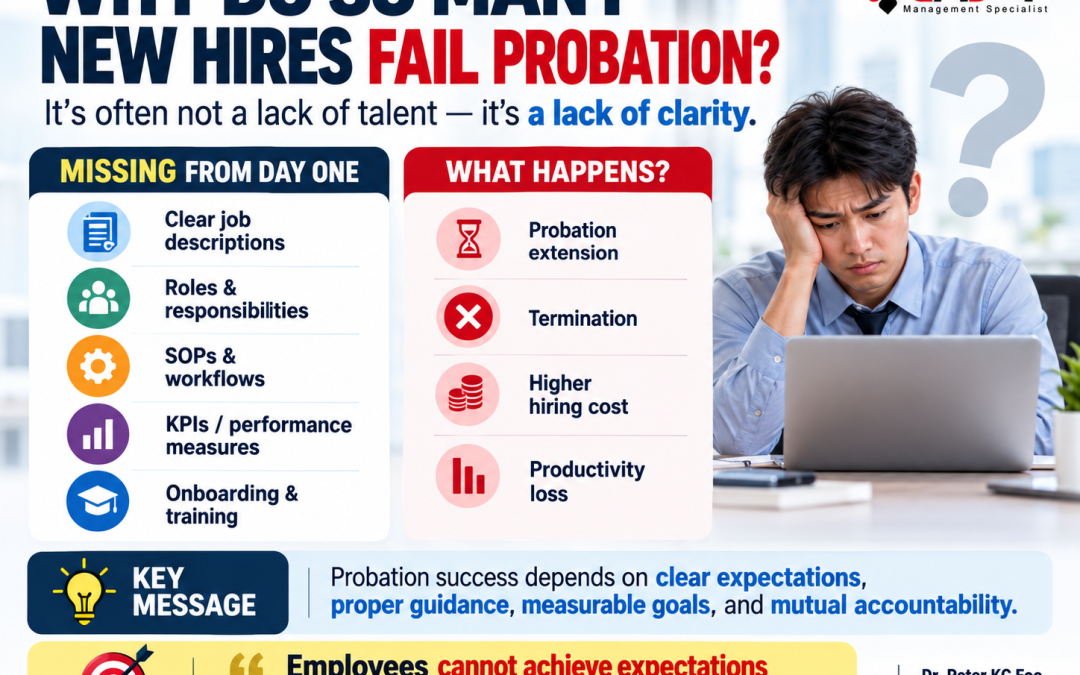
The Hidden Cost of Unclear Job Roles in Recruitment
Many employers invest significant time and money in recruitment, hoping to attract talented individuals who can contribute to business growth. However, one of the most common reasons for employee underperformance and probation failure is not a lack of talent or commitment, but rather a lack of clarity in job descriptions, roles, responsibilities, workflows, and performance expectations.
This issue often creates frustration for both employers and employees. The employer believes the employee is not delivering expected results, while the employee feels unsupported, confused, and uncertain about what success actually looks like.
As a business consultant, I frequently encounter organizations facing recurring recruitment challenges caused by unclear job expectations. In many cases, the problem originates long before the employee’s first day at work.
Case Scenario: The Failed Probation
A medium-sized company hired a Marketing Executive with a six-month probation period. During the interview, the candidate was informed that the role involved digital marketing, customer engagement, and business development support.
However, after joining the company, the employee discovered that the position also included:
- Content creation
- Graphic design
- Event management
- Customer service support
- Report preparation
- Sales follow-up activities
Unfortunately, there was no detailed job description, standard operating procedure (SOP), workflow guide, or structured onboarding program.
The employee attempted to fulfill all assigned tasks but often received feedback such as:
- “You should know this already.”
- “This is not what we expected.”
- “You need to be more proactive.”
- “Your performance is below expectations.”
As the six-month probation period approached its end, management faced a difficult decision.
Should they:
- Confirm the employee?
- Extend the probation period?
- Terminate employment due to underperformance?
The employee, on the other hand, questioned whether the company had provided sufficient guidance, training, and performance expectations from the beginning.
This situation resulted in uncertainty, frustration, and dissatisfaction on both sides.
Root Causes of Employee Underperformance
Many organizations mistakenly assume that employees fail because they lack competency. However, the actual root causes often include:
1. Unclear Job Descriptions
A vague job description creates confusion regarding responsibilities, priorities, and accountability.
Employees cannot effectively perform when they are uncertain about:
- What tasks they own
- What outcomes are expected
- Which responsibilities take priority
- How their performance will be measured
2. Lack of Structured Onboarding
Recruitment does not end when an employee signs an employment contract.
New hires require:
- Orientation
- Training
- Process explanations
- Department introductions
- SOP familiarization
Without a structured onboarding program, employees spend valuable time attempting to understand organizational practices through trial and error.
3. Absence of Workflows and SOPs
Expecting employees to perform independently without providing workflows or guidance is unrealistic.
A documented workflow helps employees understand:
- What needs to be done
- How tasks should be completed
- Who is involved in the process
- When actions should be taken
- What standards are expected
4. Undefined Performance Metrics
Many employees are evaluated based on subjective opinions rather than measurable outcomes.
For example:
Instead of saying:
“Improve marketing performance.”
A measurable expectation would be:
- Generate 50 qualified leads monthly.
- Increase social media engagement by 20%.
- Prepare weekly marketing reports.
- Achieve campaign completion within agreed timelines.
Clear metrics eliminate misunderstandings during performance reviews.
The Probation Review Dilemma
When probation reviews arrive, many managers struggle to make fair assessments because expectations were never clearly established.
Common comments include:
- Employee lacks initiative.
- Employee is not independent.
- Employee cannot meet expectations.
- Employee requires too much supervision.
However, an important question should always be asked:
Were the expectations clearly communicated and adequately supported from Day One?
If the answer is no, extending probation or terminating the employee may only address the symptom rather than the root cause.
The company may simply repeat the same hiring mistake with the next employee.
The True Cost of Poor Hiring Practices
When an employee fails probation and leaves the organization, the consequences extend beyond the vacant position.
Costs may include:
Financial Costs
- Recruitment advertising
- Interview expenses
- Administrative processing
- Training costs
- Productivity loss
Operational Costs
- Project delays
- Increased workload for existing employees
- Customer dissatisfaction
- Reduced team efficiency
Organizational Costs
- Low employee morale
- High turnover rates
- Negative employer branding
- Reduced trust in management
Repeated hiring failures can become a cycle that continuously drains organizational resources.
The Consultant’s Perspective: A Shared Responsibility
From my experience as a business consultant, successful employment relationships depend on proactive collaboration between employers and employees.
Responsibilities of Employers
Employers should:
✅ Develop clear job descriptions.
✅ Define roles and responsibilities.
✅ Establish measurable Key Performance Indicators (KPIs).
✅ Provide onboarding and training.
✅ Document workflows and SOPs.
✅ Schedule regular performance reviews.
✅ Create a supportive working environment.
Responsibilities of Employees
Employees should:
✅ Seek clarification when uncertain.
✅ Take ownership of assigned responsibilities.
✅ Actively learn company processes.
✅ Request feedback regularly.
✅ Document progress and achievements.
✅ Demonstrate initiative and accountability.
Creating a Successful Probation Framework
Organizations can significantly improve employee success rates by implementing a structured probation management system.
First Month
- Orientation and onboarding
- Job scope briefing
- Workflow training
- Goal setting
Second to Third Month
- Coaching sessions
- Skills development
- Performance monitoring
- Continuous feedback
Fourth to Sixth Month
- Independent task execution
- KPI evaluation
- Performance assessment
- Career development discussion
This allows potential issues to be addressed early rather than waiting until the end of probation.
Conclusion
Employee underperformance is not always the result of incompetence or lack of commitment. In many cases, it is the outcome of unclear expectations, insufficient guidance, and inadequate performance management systems.
A well-defined job description, structured onboarding process, documented workflows, and measurable performance indicators create a strong foundation for success.
When employers and employees share a clear understanding of responsibilities, expectations, and objectives from the beginning, the probability of successful confirmation increases significantly. More importantly, organizations can reduce turnover, improve productivity, and build a workforce capable of performing independently and delivering meaningful results.
The most effective recruitment strategy is not simply hiring the right person. It is ensuring that the right person is given the right guidance, structure, and support to succeed.
“Clarity creates accountability, accountability drives performance, and performance builds sustainable business success.”
– Dr. Peter KC Foo, Business Consultant
